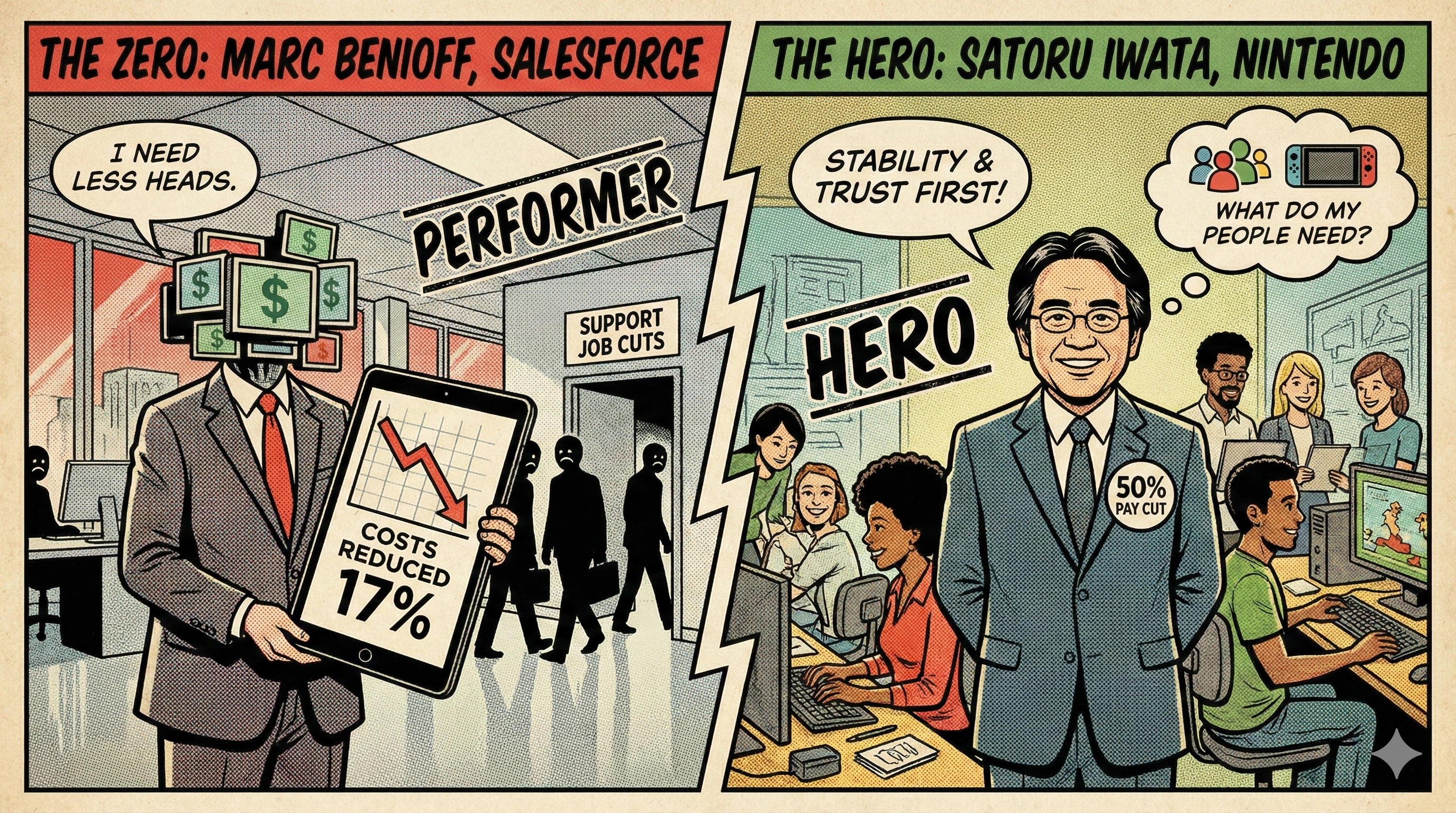
THE ZERO: Marc Benioff, Salesforce
The story: In August 2025, Benioff told the AI for Good Global Summit that AI wouldn't lead to mass layoffs, promising "radical augmentation" of the workforce. Three weeks later, he revealed on a podcast that Salesforce had cut 4,000 customer support jobs—from 9,000 to 5,000—stating "I need less heads."
Why it's performer: His mind was filled with efficiency metrics and cost reduction. He said AI agents now handle 50% of work and reduced support costs by 17%. He called his employees "heads"—a unit of cost, not people. He promised one thing publicly while executing the opposite privately. The story was always about his Agentforce product, his cost savings, his vision.
Salesforce's defense: They claimed some staff were "redeployed" into sales or other roles, and that some reduction came from hiring freezes rather than terminations. But the intent was clear—the goal was not to elevate the human, but to eliminate the "head."
What heroic would look like: A hero in Benioff's position would have said, "We're seeing AI handle more work. Here's our 18-month plan to retrain our support team for higher-value roles—and I'm taking a pay cut to fund it." He would have filled his mind with the question: What do these 4,000 people need to thrive in this transition?
THE HERO: Satoru Iwata, Nintendo
The story: In 2013, Nintendo's Wii U flopped. The company faced years of losses. To avoid layoffs, Iwata took a 50% pay cut to help pay employee salaries, saying a fully-staffed Nintendo would have a better chance of rebounding.
Why it's heroic: "If we reduce the number of employees for better short-term financial results, employee morale will decrease, and I sincerely doubt employees who fear that they may be laid off will be able to develop software titles that could impress people around the world."
His mind was filled with one question: What do my people need to create something great? The answer wasn't "less heads." It was stability, trust, and the knowledge that their leader would sacrifice before they would.
The result: That team built the Nintendo Switch—one of the most successful consoles in history. The hero's journey completed.
THE FRAMEWORK
| Aspect | Performer | Hero |
|---|---|---|
| Mind filled with | Own metrics, image, efficiency | Others' needs, growth, dignity |
| Language | "Heads," "rebalancing," "restructuring" | "Team," "people," "our company" |
| Sacrifice | Others sacrifice for the leader | Leader sacrifices for others |
| Timeline | Short-term optics | Long-term flourishing |
| Path | A to B directly (cut costs) | A to B through C (invest in people) |