THE ZERO: Ying Liu, Kyte Baby CEO
The story: In January 2024, Marissa Hughes—an employee at baby clothing company Kyte Baby—adopted a premature infant born at 22 weeks. The baby weighed barely over a pound and had various health concerns requiring NICU care.
Marissa requested to work remotely from the NICU so she could stay with her child while keeping her job. CEO Ying Liu personally vetoed the request.
"It was never my intention to quit — I was willing to work from the NICU!" Marissa tells TODAY.com in her first media interview. "I did tell them, 'This is a slap in the face ... My child is fighting for his life.'"
But when she requested to work remotely while staying with her baby at the NICU, the company fired her, according to a TikTok video posted Wednesday by a woman who says she is Hughes' sister.
The irony: Kyte Baby is a "family-oriented company" that sells baby clothing. Kyte Baby's social media presence also curates a mother-friendly image. "We work at Kyte Baby: Of course we're going to bring our kids to work," an employee says in one TikTok video.
Liu had even written in 2021: "I have no problem with my employees being home and working while taking care of their kids. Why should they come back to the office five days a week when they're still very productive and can perform?"
After the story went viral, Liu posted a scripted TikTok apology. The internet destroyed it. The speech got harsh reviews on TikTok, where people said Liu sounded rehearsed and inauthentic. Dozens of moms made videos saying they were once loyal Kyte customers, but would now boycott the company.
Hours later, Liu posted a second video: "So, I just posted an official apology on TikTok. And the comments were right — it was scripted. I memorized it. I basically just read it, it wasn't sincere and I've decided to go off-script."
"I was the one that made the decision to veto her request to go remote while she has to stay in the NICU to take care of her adopted baby. And when I think back, this was a terrible decision — I was insensitive, selfish and was only focused on the fact that her job had always been done on-site and I did not see the possibility of doing it remotely."
A crisis expert summarized: "This is a classic case of a brand not walking the walk."
Marissa said she won't be returning to the company.
Why it's performer: Kyte Baby markets itself on supporting mothers and babies. Every TikTok shows dancing employees with children. The brand promise is family.
When an actual mother needed actual support—the chance to work from a NICU while her premature baby fought for his life—the CEO said no.
Liu's first apology was scripted. Her second admitted the first was insincere. Both came only after viral backlash, not after the harm was done. The sequence reveals what filled her mind: reputation management, not the employee.
The cruelest detail: Liu is herself a mother of five. She runs a baby company. She wrote publicly about supporting work-from-home mothers. When the test came, she failed.
THE HERO: Yvon Chouinard, Patagonia Founder
The story: In 1983, Patagonia co-founder Malinda Chouinard did something unusual: she parked a trailer in front of the Great Pacific Iron Works so that her friend and colleague Jennifer Ridgeway, the head of marketing and advertising, had a place to retreat to when she needed to nurse her colicky newborn.
That trailer became something more.
The Chouinards believed that providing onsite child care was a moral imperative. Their early employees, like Ridgeway, were friends and they looked at their lives holistically.
In 1984, Patagonia opened an on-site cafeteria offering "healthy, mostly vegetarian food," and started providing on-site child care.
Four decades later, the results are remarkable: "We have 25 people working at Patagonia who went through our childcare program." Employees who were cared for as infants are now managers at the company.
Patagonia doesn't have childcare because it's trendy — in fact, the percentage of companies offering that benefit remains small (8%) and static. But every time Patagonia leans into its values, the company seems to thrive.
Chouinard's philosophy: "Every time we've elected to do the right thing, it's turned out to be more profitable."
In 2022, Chouinard went further—donating his entire $3 billion company to fight climate change. "Instead of extracting value from nature and transforming it into wealth, we are using the wealth Patagonia creates to protect the source. We're making Earth our only shareholder. I am dead serious about saving this planet."
Why it's heroic: When Chouinard saw an employee struggling to nurse a colicky newborn, he didn't see a policy problem. He saw a human being who needed help.
The trailer became childcare. The childcare became culture. The culture became 25 former program children now working as adults at the company.
The product innovation, the stewardship, and the happy workforce all flow out of the profoundly simple goal at Patagonia: "Do well and do good."
Chouinard didn't create family benefits to win talent wars or manage PR crises. He created them because he looked at employees as whole human beings—not as "resources" to be optimized.
THE FRAMEWORK
| Aspect | Performer (Liu/Kyte Baby) | Hero (Chouinard/Patagonia) |
|---|---|---|
| The situation | Employee needed remote work for NICU baby | Employee needed to nurse colicky newborn |
| Response | Vetoed request, effectively fired her | Parked a trailer, started childcare program |
| Timing | Apology came after viral backlash | Support came before anyone asked |
| Brand alignment | Baby company denied support to mother | Outdoor company built family culture |
| First apology | Scripted, immediately criticized | N/A—no apology needed |
| Outcome | Employee declined to return | 25 former program children now work there |
| Philosophy | "Her job had always been done on-site" | "Look at employees' lives holistically" |
| Mind filled with | Policy adherence, damage control | Human beings who needed help |
THE LESSON
Both leaders run companies. Both faced employees with young children who needed flexibility. The difference is entirely in what filled their minds.
Ying Liu saw an employee requesting remote work. She saw policy. She saw precedent. She saw an on-site role that "couldn't" be done remotely. Only after TikTok exploded did she see a mother whose child was fighting for his life.
Yvon Chouinard saw a friend struggling to nurse her baby. He didn't see policy. He parked a trailer.
"It's also important to point out that this is a brand that promises to understand motherhood and be there to support moms, especially new moms. The weight of breaking that promise to moms is much more serious than what brands outside the parenting category might encounter."
Kyte Baby's marketing says "family." Its policy said "on-site requirements."
Patagonia doesn't have marketing about childcare. It has 40 years of children growing up at the company and returning as adults to work there.
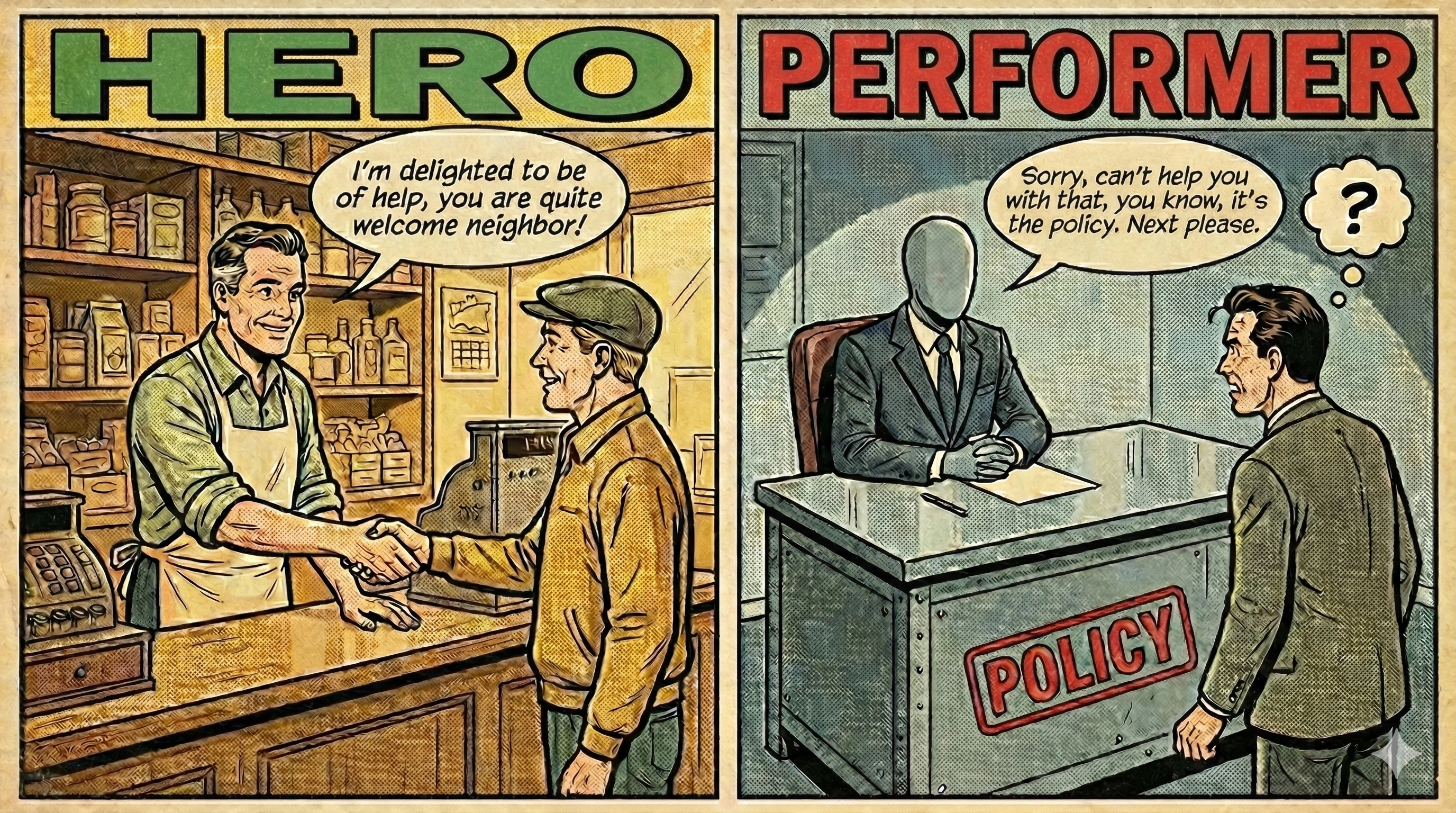
The difference between a performer and a hero isn't what they say about values. It's what they do when values cost something.
Liu's apology only came after going viral. Chouinard's trailer came before anyone asked.
The hero doesn't wait for a PR crisis to see employees as human beings. The hero sees them that way from the start.