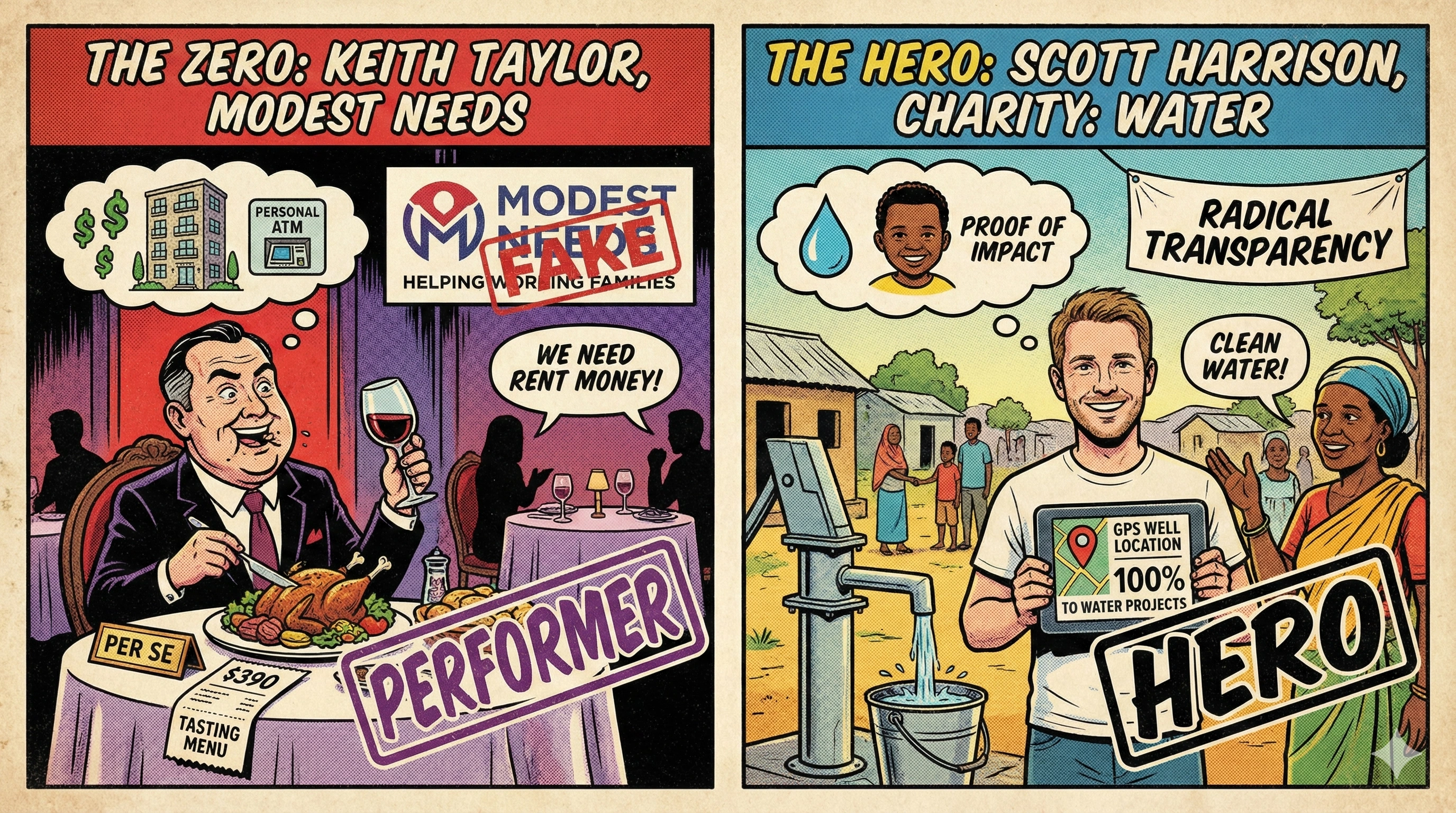
THE ZERO: Keith Taylor, Modest Needs
The story: Keith Taylor founded Modest Needs in 2002 with a beautiful mission - helping working families with unexpected expenses that put them at risk of homelessness. The charity was featured on CNN, Today, Oprah, Forbes, and The New York Times. Taylor became the face of innovative philanthropy.
Behind the scenes, he was stealing from the very families he claimed to serve.
Since at least 2015, Taylor embezzled more than $2.5 million from the charity and its donors and used that money to fund his lavish personal spending.
Taylor regularly dined at Per Se, Jean-Georges, Masa, and Marea in midtown Manhattan, sometimes as often as twice a day, spending more than $320,000 of charity funds at New York City restaurants and steakhouses.
Funds donated to the charity paid over $300,000 of Taylor's rent for a luxury apartment on the 30th floor of a midtown Manhattan skyscraper.
Taylor also used charity funds to buy himself expensive electronics, pay over $100,000 to food delivery services, and pay for his own medical expenses.
To hide the theft, Taylor attempted to hide his embezzlement of charity funds by creating a fake board of directors and claiming it had approved his personal spending. Taylor's acquaintances who were listed as the charity's board members included a bartender from Jean-Georges, a friend, and his house-cleaner, none of whom ever attended a board meeting or even knew that they had been listed on the charity's website.
Even after his arrest in June 2024, Taylor continued to use Modest Needs' funds for his personal expenses, including to pay for meals, medical expenses, and rent for his luxury apartment, all in violation of the conditions of his pretrial release.
The U.S. Attorney's statement: "Keith Taylor misled donors into believing their contributions would support families in need, instead diverting funds for his lavish lifestyle. His actions defrauded donors and robbed those in desperate need."
Why it's performer: Taylor's mind was filled with himself so completely that he couldn't even see the families he was supposedly serving. They were abstractions - props for his public image while he gorged on $390 tasting menus funded by people who thought their $50 donation was preventing a family from becoming homeless.
The name "Modest Needs" became a cruel joke. His needs were anything but modest.
THE HERO: Scott Harrison, charity: water
The story: Scott Harrison spent a decade as a nightclub promoter in New York City, getting paid to party, living what he later described as a selfish and empty life. At 28, broke and spiritually bankrupt, he volunteered for Mercy Ships - a hospital ship serving impoverished communities in West Africa.
He had to pay around $500 a month to cover living expenses. Despite having a high salary in the past, Harrison was almost broke at that stage.
What he witnessed changed him. He took 50,000 photos of patients with tumors, leprosy, and cleft lips. He learned that contaminated water was the root cause of so much disease and suffering.
In 2006, Harrison founded charity: water with a radical premise: "I raised overhead money, like staff salaries and office rent, from private donors, so that 100% of the public's money always goes straight to water projects."
When faced with skepticism about charity transparency, Harrison approached charity: water's donation process like its own product, thinking about the entire conversion cycle with a potential donor from start to finish.
That meant if someone donated $100 via credit card and they only received $97 because of transaction fees, they would make up the difference to maintain their 100% promise.
In 2008, the charity nearly died. Harrison had more than $800,000 in the bank to build wells but was within weeks of running out of money to make payroll and pay overhead. Friends recommended he borrow money from his well-building fund to pay his operations expenses, but Harrison refused.
"I remember being so outraged at that idea," Harrison said. "I was going to shut the organization down and say that 100 percent model just didn't work."
He would rather close than break his promise to donors. A stranger walked in and wrote a million-dollar check to save the organization.
What started in a tiny apartment became a global movement - bringing clean water to over 20 million people.
Why it's heroic: Harrison's mind is filled with one question: "Did this donor's money actually help someone, and can I prove it?"
He built GPS coordinates into every well so donors could see exactly where their money went. He created radical transparency because he understood that trust, once broken, destroys the entire charitable sector.
When faced with financial crisis, his instinct wasn't "How do I survive?" It was "I cannot break my promise to the people who trusted me."
THE FRAMEWORK
| Performer (Taylor) | Hero (Harrison) |
|---|---|
| View of donors: Personal ATM | View of donors: Sacred trust |
| Response to oversight: Created fake board | Response to oversight: Built radical transparency |
| When organization struggles: Kept stealing | When organization struggles: Would rather close than break promise |
| Mind filled with: Per Se reservations | Mind filled with: GPS coordinates of wells |
| Daily question: "What can I extract?" | Daily question: "Can I prove this helped someone?" |
THE LESSON
The nonprofit sector runs on trust. Every dollar given is an act of faith - someone believing their money will help.
Taylor exploited that faith. He saw donors not as partners in a mission but as marks to be deceived. Every media appearance was a performance, every heartwarming story a cover for theft. When he sat in Per Se spending $390 on dinner, families the charity was supposed to help were choosing between rent and groceries.
Harrison built the opposite. When he couldn't afford to make payroll, he refused to touch the well-building fund because that money belonged to the mission, not to him. The organization's survival mattered less than keeping his word.
The difference isn't about salary - Harrison takes compensation (transparently, from a separate fund). The difference is whose needs fill your mind when no one is watching.
Taylor, alone in his 30th-floor apartment, ordered Uber Eats with stolen charity funds.
Harrison, facing bankruptcy, prepared to shut down rather than betray a single donor.
One was performing charity. One was living it.