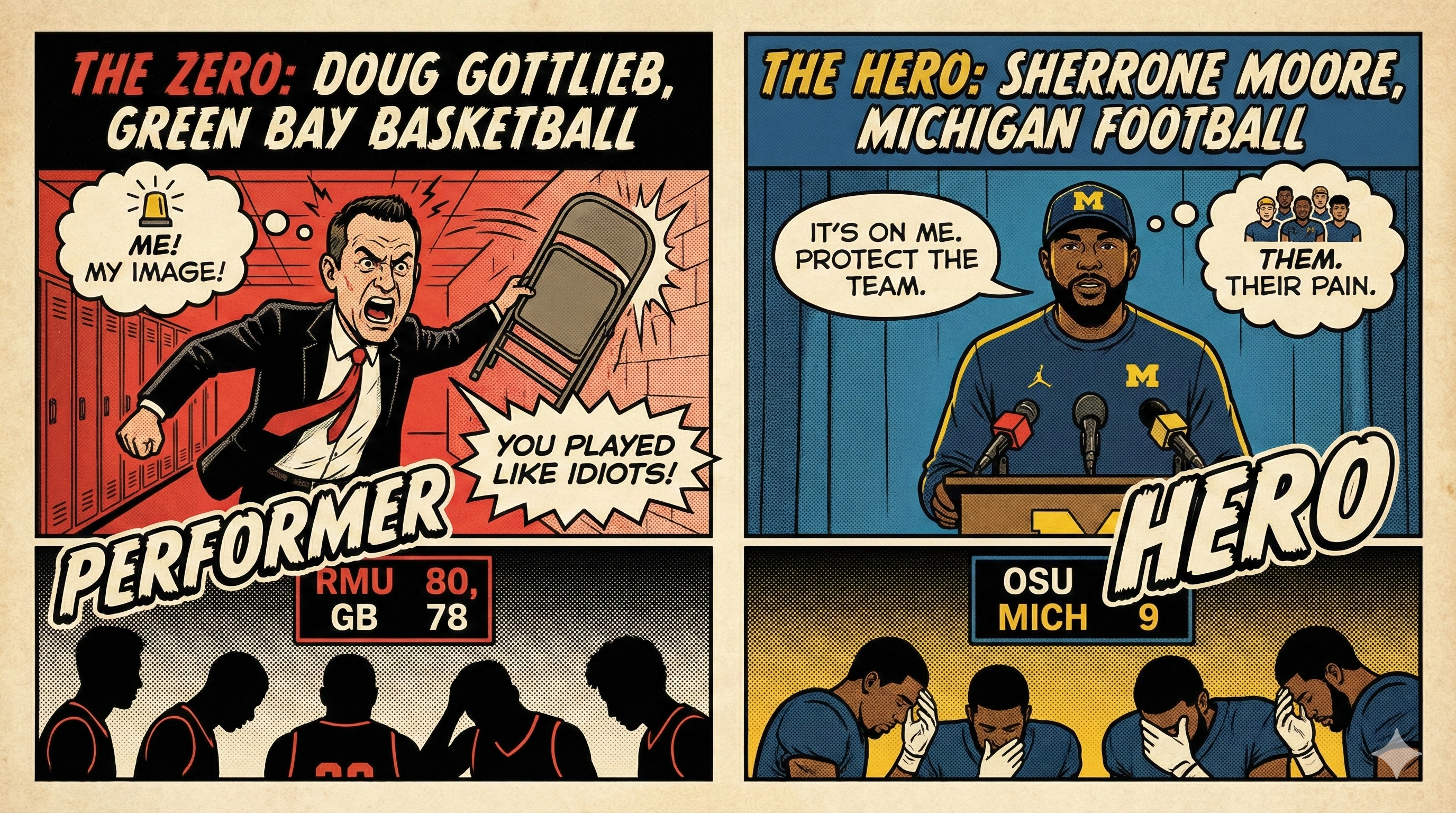
THE ZERO: Doug Gottlieb, Green Bay Basketball
The story: Doug Gottlieb was hired as head coach of the University of Wisconsin-Green Bay men's basketball team in May 2024 despite having zero prior coaching experience. He's a radio personality who hosts a nationally syndicated show on Fox Sports Radio - a job he kept while coaching.
His first season: 4-28.
On December 4, 2025, his team blew an 11-point lead with under four minutes remaining and lost 80-78 to Robert Morris at home. As he walked off the floor, Gottlieb grabbed a chair and appeared to toss it against a wall.
Then came the press conference.
"Yeah, we're actually a good basketball team. I know it's surprising to people. We're actually pretty good, but we played like idiots at the end of the game."
"We didn't defend the 3-point line," he said. "And we have guys that are not listening. So it happens. We lost the game."
Asked Thursday if he had any comment about the chair-throwing incident, Gottlieb told ESPN, "Nope."
The next day, on his radio show, Gottlieb offered this: "I acted like a petulant child."
But even then: "You can't tell your players to keep their cool, when; granted, it was after the game; granted, it was off the court, and it was tucked in a kind of vomitorium area. Still, it's within sight of a camera to where they get you doing it, and it becomes bigger than the actual story."
The "actual story," according to Gottlieb? "We frankly choked. Frankly choked. It's really what happened."
His record as head coach: 8-34.
Why it's performer: Gottlieb's mind was filled with his own frustration, his own embarrassment, his own image. When the loss happened, his first instinct was violence (the chair), then public blame ("played like idiots," "guys that are not listening"), then excuse-making ("it was off the court," "tucked in a vomitorium area").
A performer asks: "How does this make ME look?"
Even his half-apology centered himself - the problem wasn't that he humiliated his players on national television. The problem was that a camera caught him.
THE HERO: Sherrone Moore, Michigan Football
The story: On November 29, 2025, Michigan lost 27-9 to Ohio State - their biggest rival - in a blowout that knocked them out of playoff contention. The Wolverines failed to score a touchdown and managed only 63 passing yards.
It was a brutal, humiliating loss.
Head coach Sherrone Moore stepped to the podium. "I'll put it on me," Moore said. "Always put stuff on me. It's got to be better."
No chair throwing. No calling players idiots. No blame-shifting.
"Not (feeling) good, right?" Moore said. "I mean, it stings. Everybody stings. You sting for the seniors. You sting for the program. When you're in this 24/7, when you're in this 365, it hurts, you know."
"And you work tirelessly to make this, you know, be successful. So, not just about me. It's really about the kids and all the hard work. So I'll put it on me."
Moore had only taken over as head coach in January 2024 after Jim Harbaugh left for the NFL. He inherited enormous expectations after Michigan's national championship. When those expectations weren't met, he didn't point fingers at the players he inherited or the system he walked into.
He owned it.
Why it's heroic: Moore's mind was filled with the seniors who just played their last game against Ohio State. With the program. With the kids who worked tirelessly. His pain was real - "it stings" - but his first instinct was to protect his players from blame and take it on himself.
A hero asks: "How can I shield my people from this?"
The loss was just as painful as Gottlieb's. The public humiliation arguably worse (Ohio State-Michigan is one of the biggest rivalries in sports). But Moore understood that the moment wasn't about him. His players were hurting. His job was to absorb the criticism so they didn't have to.
THE FRAMEWORK
| Performer (Gottlieb) | Hero (Moore) |
|---|---|
| First action after loss: Threw furniture | First action after loss: Went to podium |
| Public statement: "Played like idiots" | Public statement: "I'll put it on me" |
| Who absorbs blame: Players | Who absorbs blame: Coach |
| Focus of postgame: His frustration | Focus of postgame: His players' pain |
| Effect on team: Publicly humiliated | Effect on team: Publicly protected |
| Mind filled with: How this looks for him | Mind filled with: How his players feel |
THE LESSON
Both coaches experienced the same thing: a painful, embarrassing loss at a critical moment.
The difference is what filled their minds in that moment.
Gottlieb's mind was filled with himself. His frustration. His embarrassment. His need to express rage. His need to distance himself from failure by labeling his players as "idiots" and "guys that are not listening."
Moore's mind was filled with his players. Their pain. Their effort. Their sacrifice. His job, as he saw it, was to stand between them and the criticism - to be the shield, not the sword.
This is the difference between a performer and a hero. Both feel the pain. The performer inflicts it outward. The hero absorbs it inward.
Gottlieb told the world his players were idiots. Moore told the world to blame him.
One coach made himself feel better at his players' expense. The other made himself feel worse so his players wouldn't have to.
That's not strategy. That's character.
THE IRONY
Gottlieb has been a sports commentator for decades. He's spent years analyzing leadership, critiquing coaches, discussing what makes teams succeed or fail.
He knew better.
But knowing what's heroic and being heroic are not the same thing. When the moment came - when he was embarrassed and angry and looking for somewhere to put his pain - he chose to put it on his players.
Moore, in his first year as a head coach at Michigan, instinctively protected his team.
One had decades of talking about leadership. One had months of actually leading.
The difference showed.